


2026 Smart Litter Box Buying Guide: Comparing 5 Popular Options And Choosing The Right One
Preface
Recently, I've been spending quite a bit of time comparing smart litter boxes, and one thing became clear very quickly: choosing one is much harder than it looks.
Prices vary widely, and almost every brand seems to have a long list of features - automatic cleaning, app control, health monitoring, odor control, multi-cat recognition, automatic litter refilling, and more.
At first, I was also drawn to these smart features.
But after looking more closely at different products, I started to think that buying a smart litter box shouldn't be only about how "smart" it is.
For everyday cat owners, I think the more practical questions are:
Does litter stick to the bottom?
Will my cat actually use it?
Is it easy to clean after months of use?
If one component fails, can it be replaced separately, or does the whole machine need repair?
Will I have to keep buying proprietary consumables?
And if you have more than one cat, there are even more things to consider: interior space, waste-bin capacity, cleaning frequency, and whether cats of different sizes can comfortably share the same unit.
So instead of simply comparing which machine has the longest feature list, I looked at five representative smart litter box options from the perspective of daily use, cat comfort, maintenance, smart features, and long-term ownership cost.
Zhicheng Technology Smart Litter Box | What Caught My Attention Was the Long-Term Cost of Ownership
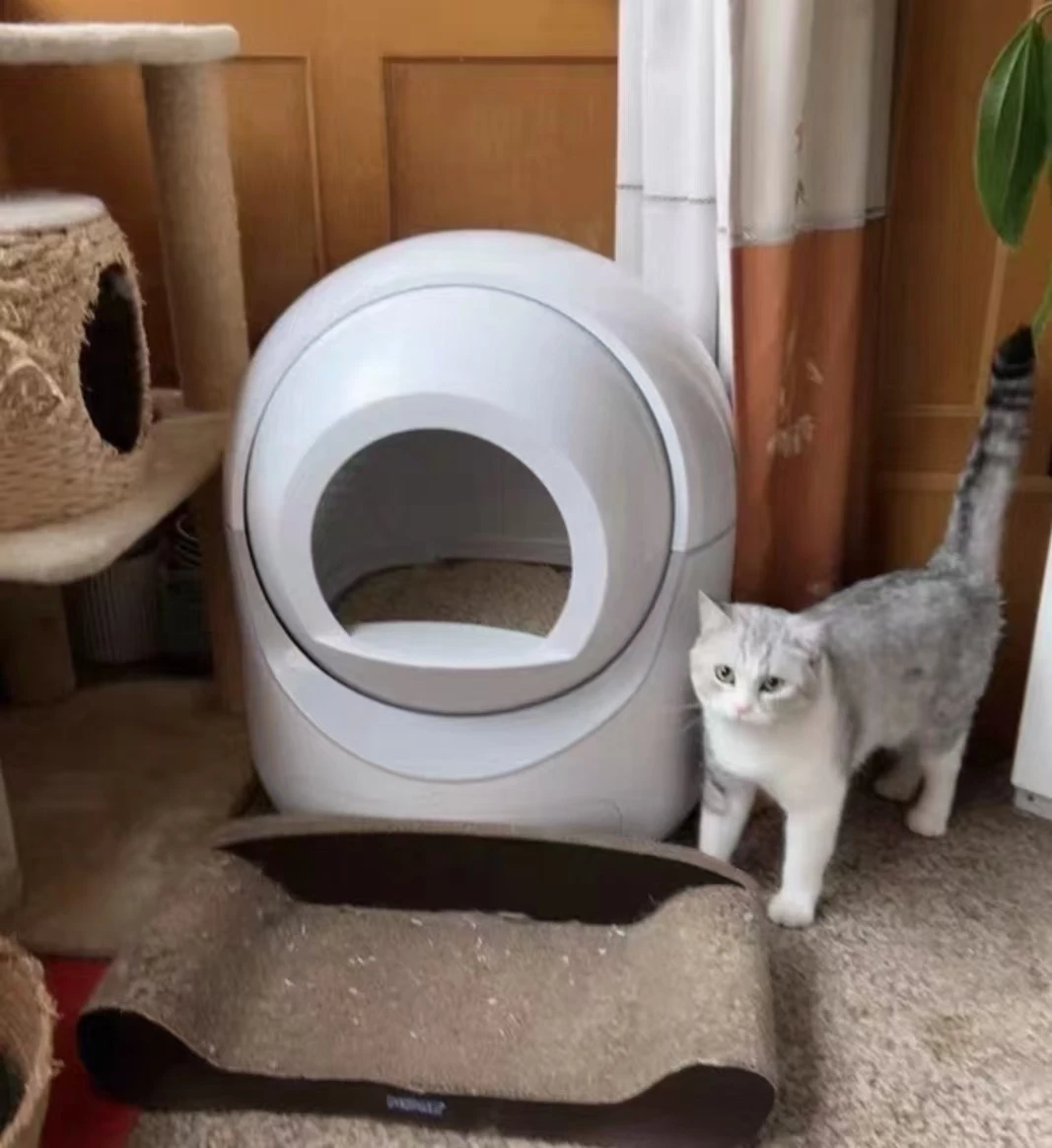
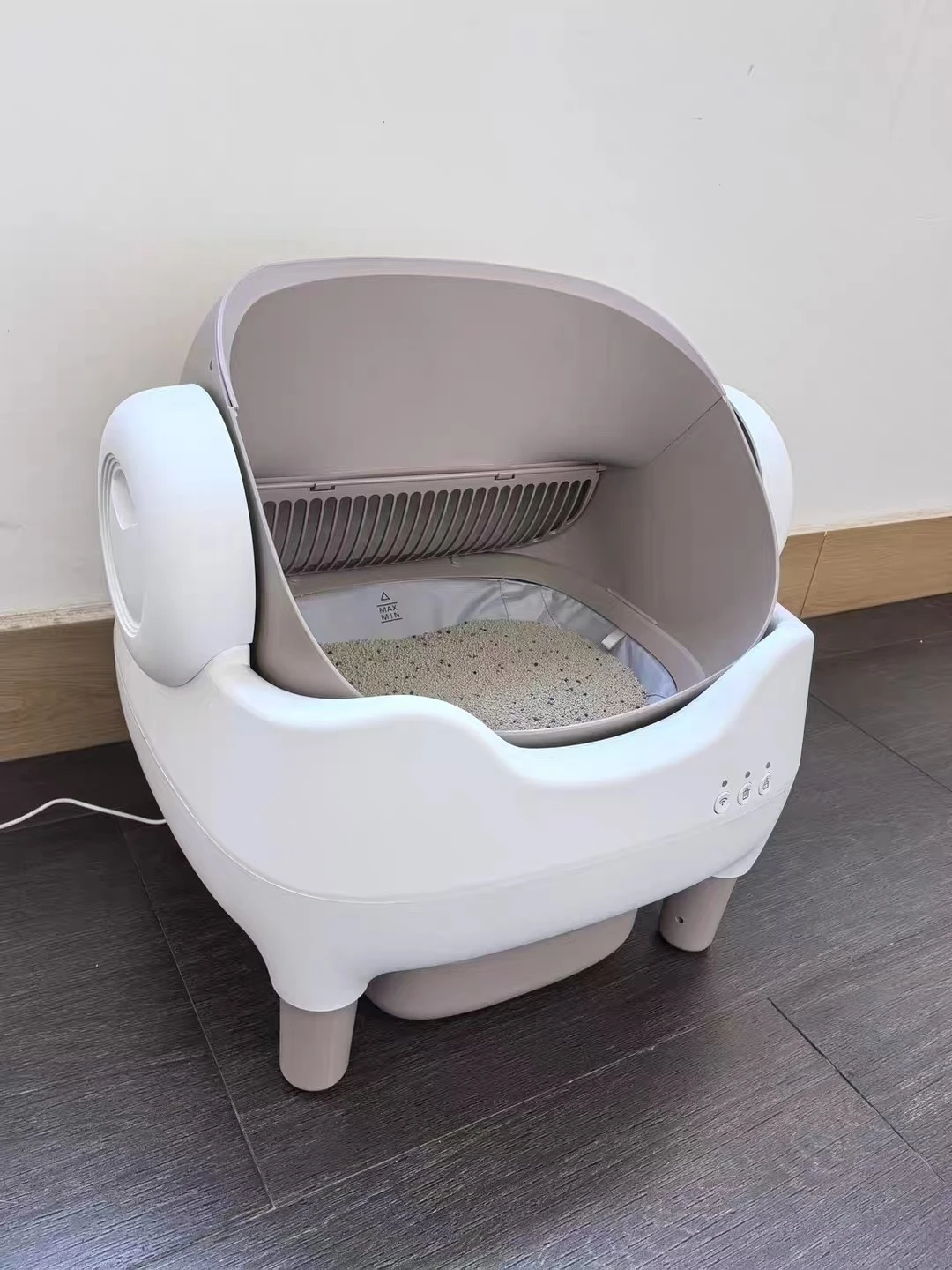
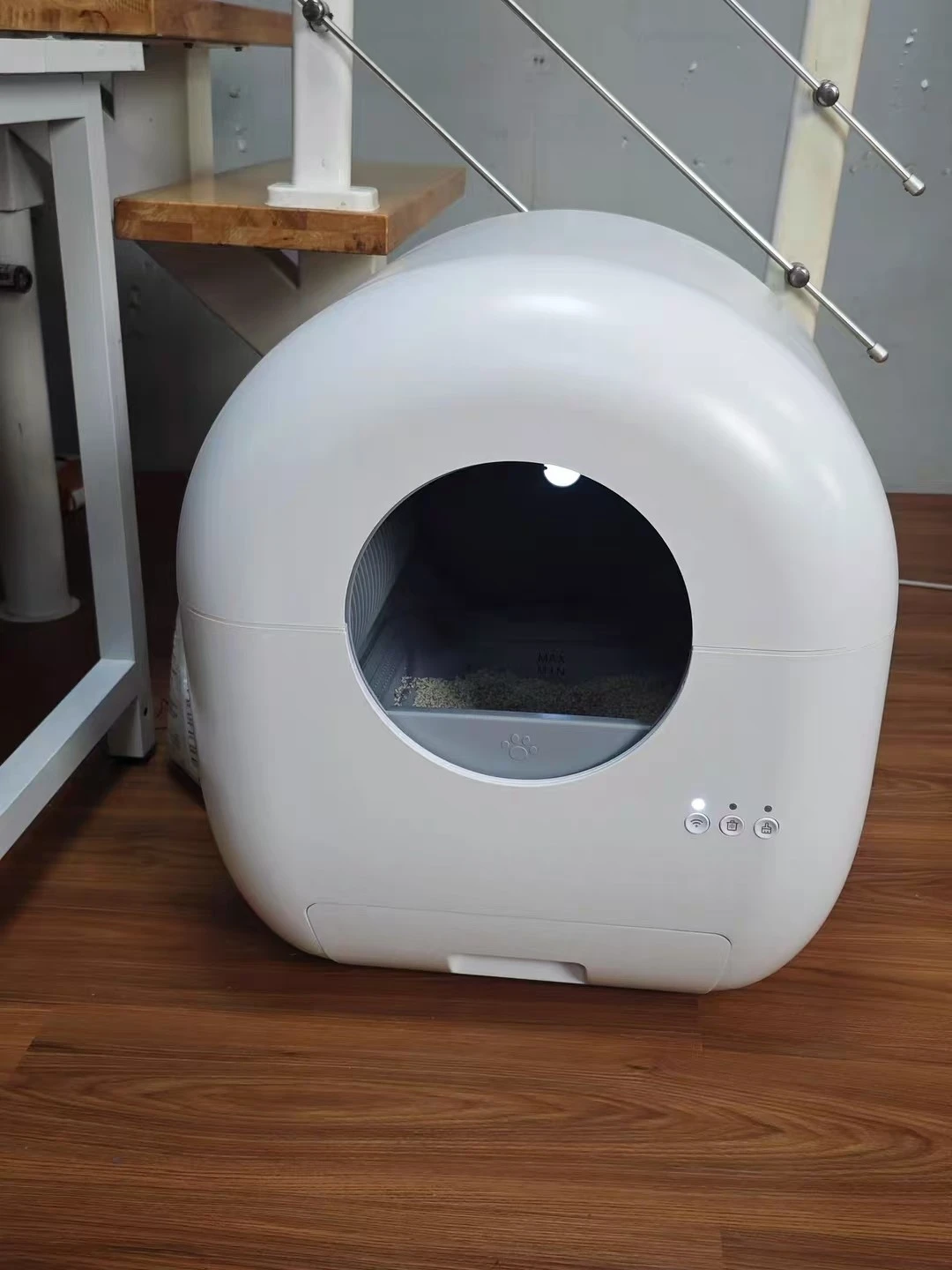
Among the products I compared, what stood out to me about Zhicheng Technology was that the design doesn't seem to focus only on adding more smart functions.
It pays attention to some of the less glamorous problems that can become frustrating after months of use.
Two things in particular caught my attention:
litter sticking to the bottom and maintenance.
Why do I care so much about litter sticking?
Because automatic cleaning doesn't mean zero cleaning.
If wet litter or urine clumps constantly stick to the bottom, the machine may complete its cleaning cycle, but residue can still remain.
Over time, that means more scrubbing, more odor, and more work.
Some Zhicheng Technology models use a specially designed protective mat intended to reduce sticking, leakage, and wear caused by scratching.
Personally, I find this kind of feature more practical than simply adding another page of data to an app.
For a multi-cat household, where the litter box may be used many times every day, this becomes even more important.
The repair approach is another thing I noticed
A smart litter box is still a machine.
It contains motors, sensors, filters, and moving components. If I'm buying something that I expect to use for several years, I don't assume that every component will work forever.
So one question I always ask is:
What happens when something eventually needs repair?
Zhicheng Technology uses a more modular approach, allowing certain components to be handled or replaced separately.
If only one part has a problem, replacing that component can make much more sense than dealing with the entire machine.
For a normal household, this can make maintenance easier.
For overseas customers, it matters even more. Smart litter boxes are bulky products, and shipping an entire machine back and forth can quickly become expensive.
I also like that there are both open and enclosed designs
One thing I realized during my research is that we shouldn't choose a litter box based only on what looks better to us.
Some cats are perfectly comfortable in an enclosed space.
Others simply aren't.
Zhicheng Technology offers both enclosed and open-design automatic litter boxes, with different sizes, appearances, and configurations across its product range.
For an individual cat owner, that means more flexibility to choose according to the cat's size and personality.
From a buyer or distributor's perspective, the variety becomes even more interesting.
Zhicheng Technology is a manufacturer supporting OEM, ODM, and Private Label projects. Depending on production and order requirements, different models can also be evaluated for combined purchasing and mixed-container shipments.
I think this makes sense for importers and distributors.
When entering a new market, nobody can know with absolute certainty which design local consumers will prefer.
Instead of putting the entire first shipment into one model, testing several models can reduce the risk of concentrating too much inventory in a single SKU.
Once actual sales data comes in, the next order can be adjusted accordingly.
Who I think it suits: households concerned about litter sticking, maintenance, and long-term ownership costs; multi-cat households; as well as importers, distributors, e-commerce sellers, and buyers developing their own pet brands.
Established Smart Pet Brands | Better for Owners Who Really Care About Cat Data
The second type of smart litter box takes a very different approach.
Some established smart pet brands are no longer selling just an "automatic litter box."
They are building a complete smart pet-care experience.
Multi-cat recognition, weight tracking, toilet frequency, visit duration, app-based trends and other health-related data are becoming increasingly common.
For households with several cats, I can see why this is attractive.
A basic smart litter box might tell you that a cat used the toilet.
A more advanced system may help identify which cat used it, how often, and whether its habits have changed over time.
Some premium products also combine active odor control, health analysis, and other connected pet devices.
The trade-off is fairly obvious to me:
You normally have to pay more.
And the more complicated the system becomes, the more I would want to know about app support, sensor reliability, and after-sales service before buying.
If all I really want is to stop scooping litter every day, I'm not sure I need to pay for every advanced feature.
Who I think it suits: owners with a higher budget who enjoy detailed pet-care management and want to monitor their cats' toilet habits and health-related data over time.
Homerunpet | If I Had a Maine Coon, I'd Pay Much More Attention to Interior Space
While comparing smart litter boxes, I noticed that one important specification is often overlooked:
How much usable space is actually inside?
This becomes especially important for Maine Coons, large Ragdolls, Norwegian Forest Cats, and other bigger breeds.
A machine can look huge from the outside without necessarily giving the cat much usable room inside.
Homerunpet takes a relatively clear large-space approach with some of its smart litter box designs.
For a large cat, I think interior space should rank above many smart features.
If the cat cannot comfortably turn around, dig, and cover its waste, even the best app won't make the experience better.
Some models also incorporate features such as litter-level monitoring, automatic litter refilling, and multiple safety sensors.
Of course, there is another side to having a larger interior:
The machine itself usually takes up more floor space.
If I were considering this type of product, I would measure the area where I planned to put the litter box before making the final decision.
Who I think it suits: Maine Coons, large Ragdolls, Norwegian Forest Cats and other larger breeds, as well as multi-cat households with enough room for a bigger machine.
Airrobo | If My Cat Were Nervous, I'd Look at Open Designs First
This is something I started paying much more attention to after researching smart litter boxes:
Just because the owner likes a machine doesn't mean the cat will.
Many automatic litter boxes use enclosed or rotating-drum structures.
They look neat and technologically advanced to us, but some cats simply don't like entering enclosed spaces.
This can be especially true for nervous or sensitive cats, or cats that have used traditional open litter trays their entire lives.
Airrobo has products that take a more open approach.
For these cats, I think the biggest advantage isn't necessarily a particular smart specification.
It is simply the fact that the cat has a more open field of view when entering and using the litter box.
That may make the transition from a traditional open litter tray to an automatic litter box feel less dramatic.
Open designs and flat-rake cleaning mechanisms also work differently from traditional rotating-drum systems.
It's worth mentioning that Zhicheng Technology also offers open-design automatic litter boxes.
So if I knew my cat strongly disliked enclosed spaces, I wouldn't force it into an enclosed machine simply because that model had more smart features.
I would start by comparing open designs instead.
Who I think it suits: nervous or sensitive cats, cats that dislike enclosed spaces, and households upgrading from a traditional open litter tray for the first time.
CATLINK | A Well-Rounded Option for First-Time Smart Litter Box Buyers
CATLINK was one of the easier brands for me to understand while comparing different products.
Its product range covers many of the mainstream features people now expect from a smart litter box.
Depending on the model, these can include app management, multi-cat data, toilet-use records, device status information, and abnormal-use notifications.
If someone has always used a traditional litter tray and now wants to experience automatic cleaning while also getting some smart data, this type of all-round product is easy to put on the shortlist.
But even with CATLINK - or any similar smart litter box - I still wouldn't look at the app alone.
I would compare several very practical things:
Interior space, waste-bin capacity, litter compatibility, cleaning method, consumable costs, and replacement parts.
An app may only be opened a few times a day.
The litter box itself has to work every single day.
Who I think it suits: first-time smart litter box buyers who want a relatively balanced combination of automatic cleaning and smart functions without having one highly specialized requirement.
If I Were Choosing Again, I'd Look at the Cat Before the Machine
After comparing all these options, my biggest takeaway isn't that one smart litter box is absolutely better than every other one.
Instead, I realized that I used to look at the machine first.
Now I would look at the cat first.
If I had a very large cat, interior space would be one of my first considerations.
If my cat were nervous or sensitive, I would look at open designs first.
If I had several cats, I would pay more attention to waste capacity, litter sticking, and maintenance frequency.
If health monitoring mattered a lot to me, multi-cat recognition and long-term toilet data would move much higher on my list.
And if I simply wanted to stop scooping every day without creating a new list of maintenance problems, I would pay much more attention to anti-sticking design, ease of cleaning, replaceable components, and ongoing ownership costs.
That is also why the anti-sticking and modular maintenance ideas caught my attention when I looked at Zhicheng Technology.
These features may not look as impressive on a specification sheet as health reports or advanced smart monitoring.
But if I plan to use a machine for several years, they become much more important.
My Final Buying Approach
If I had to simplify everything I learned, this is how I would approach it.
For a normal household or multi-cat home, I would focus on litter sticking, cleaning difficulty, waste-bin capacity, and maintenance.
For large long-haired cats, I would look at actual usable interior space rather than just the external dimensions of the machine.
For a nervous or sensitive cat, I would consider an open design before trying to force the cat to adapt to an enclosed one.
For data-focused pet owners, multi-cat recognition, weight tracking, toilet frequency, and long-term health-related data become more important.
And if long-term cost matters, I would definitely ask about consumables and repairs.
What needs to be purchased regularly?
Which components can be replaced separately?
If something fails, does the whole machine need to be repaired?
For importers, distributors, or buyers developing a Private Label brand, I think there is one more question to add:
Don't only ask whether the product is good. Ask whether it will be easy to sell, restock, and support after the sale.
That is one reason I found Zhicheng Technology interesting during my comparison.
Instead of offering only one smart litter box, the manufacturer has both open and enclosed product lines with different designs and configurations, while also supporting OEM and ODM projects.
For wholesale buyers, different models can be evaluated for combined purchasing depending on order and production conditions, rather than concentrating a large amount of inventory in a single SKU from the beginning.
In the end, I'm much less interested in which smart litter box has the longest feature list.
Will the cat use it? Is it easy to clean? Is it easy to repair? And can I afford to keep using it for years?
For me, those four questions matter more than simply adding more "smart" functions.
After all, no matter how intelligent it becomes, a smart litter box is still something your cat needs to use every single day.
Getting the basics right first - and then adding the smart features - makes much more sense to me.
